Introduction
Guided implantology is no longer the future of dentistry; it is the present. The ability to plan prosthetically driven restorations and execute them with pinpoint accuracy using 3D-printed stents has revolutionized patient care.
However, while the software has become highly intuitive, the hardware provided by several major implant manufacturers remains stubbornly cumbersome.
A growing point of frustration for practical implantologists is the “dual-kit” guided system.
By forcing clinicians to purchase and manage separate boxes for drilling and placement tools, companies are inadvertently creating financial and clinical barriers. Meanwhile, brands offering consolidated, single-kit solutions are rapidly capturing the market.
The Financial Burden of the Dual-Kit Model
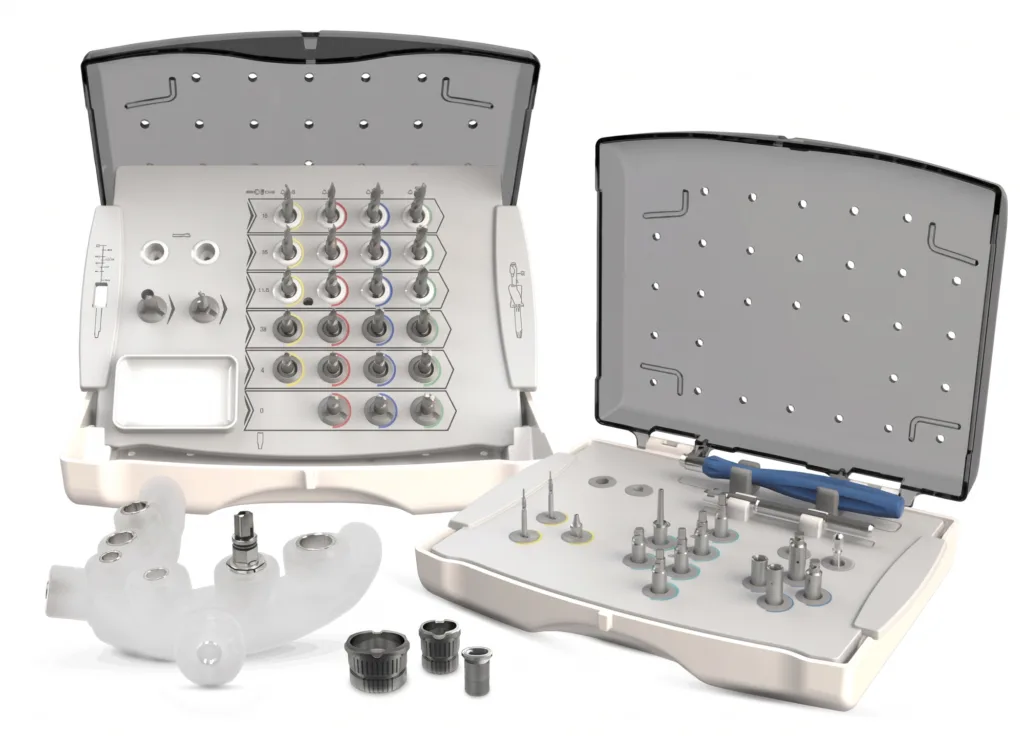
In many premium and legacy systems, entering the guided surgery space requires purchasing two distinct components: a Drill Kit (containing the site preparation instruments, sequential drills, and stoppers) and a Tool Kit (containing the fixture mounts, insertion drivers, and fixation pins).
This fragmentation effectively doubles the cost of entry. In markets like India, acquiring a complete dual-kit setup can easily exceed ₹1.5 to ₹2 Lakh.
For the average practitioner looking to adopt guided workflows, this heavy initial capital expenditure is difficult to justify, especially when standard non-guided surgical kits cost a fraction of the price.
The dual-kit model shifts guided surgery from a standard-of-care tool into a premium luxury, slowing down widespread clinic adoption.
Operatory Clutter and Workflow Friction
Beyond the invoice, the dual-kit system introduces significant friction inside the operatory.
Tray Spatial Constraints:
Surgical trays have limited real estate. Accommodating two large surgical boxes alongside standard sterile drapes, irrigation lines, and local anesthesia setups creates a chaotic, cluttered workspace for the surgical assistant.
Workflow Interruptions:
Guided surgery is designed to be seamless. Switching between a drill box and a tool box mid-procedure—moving from osteotomy preparation to implant insertion—breaks the operator’s focus and introduces unnecessary physical movement over the sterile field.
Sterilization Overhead:
Two kits mean double the maintenance. Clinic staff must clean, sort, pouch, and autoclave two separate heavy boxes after every single surgery, accelerating wear and tear while wasting valuable turnaround time.
The Single-Kit Revolution
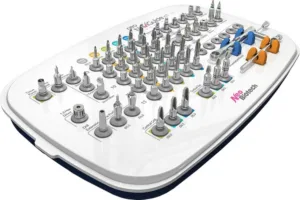
Clinicians are highly pragmatic, and the market is responding to the demand for efficiency. Systems like the Osstem OneGuide have demonstrated that the entire guided workflow can be elegantly engineered into a single, keyless surgical tray.
Single-kit systems eliminate interchangeable spoon keys and consolidate sequence drills, cortical drills, and fixture drivers into one logical layout.
The advantages are immediate:
Cost Efficiency:
A single box significantly lowers the barrier to entry, making guided surgery financially viable for a wider range of cases.
Ergonomic Simplicity:
The assistant manages one tray. The surgeon looks at one sequence. The workflow is linear and uninterrupted.
Reduced Maintenance:
One kit to prep, one kit to sterilize.
Conclusion
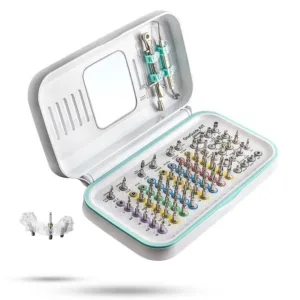
As the industry pushes toward fully digital, keyless workflows, hardware consolidation is essential.
Manufacturers that continue to separate their guided systems into multiple expensive, space-consuming kits for unknown proprietary reasons are failing to recognize the daily realities of the dental operatory. For guided implantology to achieve true universal adoption, simplicity must start in the box.

With over a decade of experience in dentistry, I specialize in diagnosing a wide range of oral diseases and have developed a deep passion for dental imaging. My interest in CBCT reporting and digital implantology led me to become a pioneer in the concept of diagnostic 3D modelling. Throughout my career, I have supported and educated numerous dentists in mastering CBCT interpretation, virtual implant planning, and the latest advancements in 3D printing for dental applications. Read more about me on the “about me” page.
- The Dual-Kit Dilemma: Why Fragmented Guided Implant Systems Are Losing Ground to Single-Kit Solutions - October 24, 2026
- Steiner’s Analysis – Free online Cephalometry - November 23, 2025
- A Complete guide to Grayscale values in CT & CBCT - November 15, 2025